
Two memos published this year frame the same opportunity from opposite ends. Sequoia's Services: The New Software shows the demand side: for every dollar spent on software, 6 are spent on services, and the winners of the next decade will sell the finished work, not tools. Natural's Agentic Payments Memo shows the settlement side: agents will execute more transaction volume than any other category, on rails rebuilt for machines.
Nobody has put the two together. This memo does.
1. The vertical Agent 2 Business thesis
Agent-to-business is the trillion-dollar prize. It is won by full vertical integration of small-business financial services: banking, payroll, accounting, taxes, and credit cards, run by one agent on one ledger.
The agent that does the financial work is also the natural counterparty for the money movement it creates. Every journal entry an AI accountant books is a payment that happened or a payment about to happen. The company that owns both the work and the rails captures the services fees and the balance-sheet economics on the same client: interchange, float, and credit spread.
That is the company Amadae is building, from the services corner in, while everyone else races toward the same center from the payments corner out.
2. Sizing the trillion
The trillion dollar opportunity collapses 5 existing silos into 1 company. Today a small business splits its financial life across a bank, a card issuer, a payroll processor, a bookkeeper, and a tax preparer. The leaders of those silos are collectively worth well over $1T.
| Pool | Size | Source |
|---|---|---|
| Accounting | $50-80B/yr | Sequoia |
| Tax advisory | $30-35B/yr | Sequoia |
| US contractor payments | ~$700B/yr | Natural |
| US payroll | ADP alone: $20.6B revenue, $37.6B deposits, $1.2B/yr yield | ADP |
| Business credit cards | $50B/yr | Ramp |
The integrated player monetizes the same client 5 ways: services fees, payroll per-seat, interchange on spend, float on deposits, and spread on credit. The float alone is a business: ADP earned $1.2B in fiscal 2025 on $37.6B of average client payroll balances. Revenue per business runs 3-5x any single-product vendor.
Churn approaches zero, because leaving means replacing your accountant, your bank, and your card on the same day. Sequoia's 6:1 services-to-software ratio says the budget is already there, currently spent on humans. Natural's memo says the roughly $700B of payment flow attached to that work "needs to be re-captured by software."
3. The end state: 5 products, 1 ledger
The end state, 10 years out, is a company where "accounting firm" and "bank" are the same entity. Each product is distribution and data for the next, and the ledger is the shared substrate:
- Accounting is the wedge. The books are the real-time source of truth for everything else, and doing the work, not selling a tool, is what earns the right to hold them.
- Taxes are a byproduct of clean books. Filing is nearly zero-marginal-cost once the ledger is right, and it locks the annual relationship.
- Payroll is a recurring ledger event with compliance attached. Whoever keeps the books already knows every number payroll needs.
- Banking makes the ledger self-writing. When the client's operating account sits on our rails, we see every transaction at authorization, not at monthly import. Reconciliation stops being a service and becomes a property of the system.
- Credit cards are the prize. We underwrite from books we keep ourselves: perfect, real-time information no outside lender has. Interchange and spread then subsidize the services, letting us price the work below any human firm.
4. The convergence is already underway
The strongest evidence for the end state is that everyone is already racing toward it from their own corner:
| Player | Starting corner | The move | What it signals |
|---|---|---|---|
| Mercury | SMB banking and deposits | Shipped Mercury Books, AI double-entry accounting inside the bank account (Sept 2026) | The bank knows the ledger owns the client. Whoever keeps the books decides where the money sits |
| Amex | Cards and charge volume | Embedding Gusto payroll into its SMB offering | Card issuers know spend alone doesn't own the client. Payroll is the stickiest workflow |
| Ramp | Spend management and cards | Partnering with 5,000 accounting firms | The accountant is the channel to SMB finance. Ramp rents that channel to sell interchange |
| Thrive | Behind Ramp, OpenAI, and Current (accounting firm rollup) | Current raised $2B+ to buy accounting firms and rewire them with AI. OpenAI holds a stake, ex-Ramp engineers embedded in the firms | The sharpest capital already believes the roll-up-and-convert thesis, and is assembling it out of 3 separate companies |
| Whop | Creator commerce platform | Embedding neobanking for its sellers | Platforms with the transaction flow want the deposit and the account, not just the checkout |
5. Why we build from the services corner
Accounting is the moat everyone above is trying to partner into. Ramp signs 5,000 accounting firms because the accountant decides which card the client swipes. Amex embeds Gusto to get near the same workflow. Mercury builds Books because the bank knows that whoever keeps the ledger decides where the money sits.
The whole landscape treats the accountant as the distribution channel and pays up. Amadae skips the rent, because Mozart is their accountant. We sell the finished work and price it against the human firm we replace. This is exactly the position Sequoia says wins.
3 structural advantages compound from there:
- Agent-native rails, already integrated. Amadae runs on agent-native banking infrastructure today: accounts, money movement, and agent-executed payments. When A2B settlement becomes the norm, we are not integrating a vendor. We are the reference case for the work-plus-payment loop Natural's memo describes.
- The data moat is the ledger itself. Every client is worth 1000x more to Amadae: full double-entry history, tax profiles, payment behavior, and years of conversation. We can cross-sell effectively because we know the full financial picture.
- No innovator's dilemma. We have no professional customers to protect. Intuit must protect the accountants who resell QuickBooks, Ramp its 5,000 firms. We can automate 100% of the work because we build from the services corner.
6. The agentic landscape versus Mozart today
The agent economy Natural's memo predicted stopped being a forecast this month. Meta launched Muse on September 8: a personal agent that acts inside your accounts, sending email, booking travel, filling out forms, and buying through Walmart, Shopify, and Expedia. Instinct, a 14-person startup whose agent pays bills, cancels subscriptions, and works the phone from its own number, raised $1B at a $10B valuation 7 weeks after launch.
The agents have arrived, and they are already spending money. The difference is where each one stops:
| Agent | Customer | Purpose | What it does | Where it stops |
|---|---|---|---|---|
| Muse (Meta) | Consumer | Personal agent for your digital life | Sends email, books travel, fills forms, buys through partner checkouts ($20-$100/mo) | Stops at the purchase: it spends money but accounts for nothing downstream, and it only reaches the merchants that let it in. Amazon already blocked it |
| Instinct | Consumer | Personal assistant for life admin | Pays bills, cancels subscriptions, negotiates and books over the phone, coordinates with other Instinct agents | Personal admin, executed one errand at a time. It moves money but holds no ledger and answers for no outcome |
| Mozart | Commercial | Replaces accountants, tax professionals, payroll teams, banks, and credit cards | Keeps the books, computes and pays the quarterlies, files the returns. Banking and cards next | It doesn't handle consumer transactions: Mozart runs a business's entire financial life, staying aware of the owner's personal finances only for tax return purposes |
7. What Mo already moves
None of this is projection. Mo books every dollar that moves through our clients' bank accounts today, which means we can measure exactly what will ride Amadae banking and cards at switch-over:
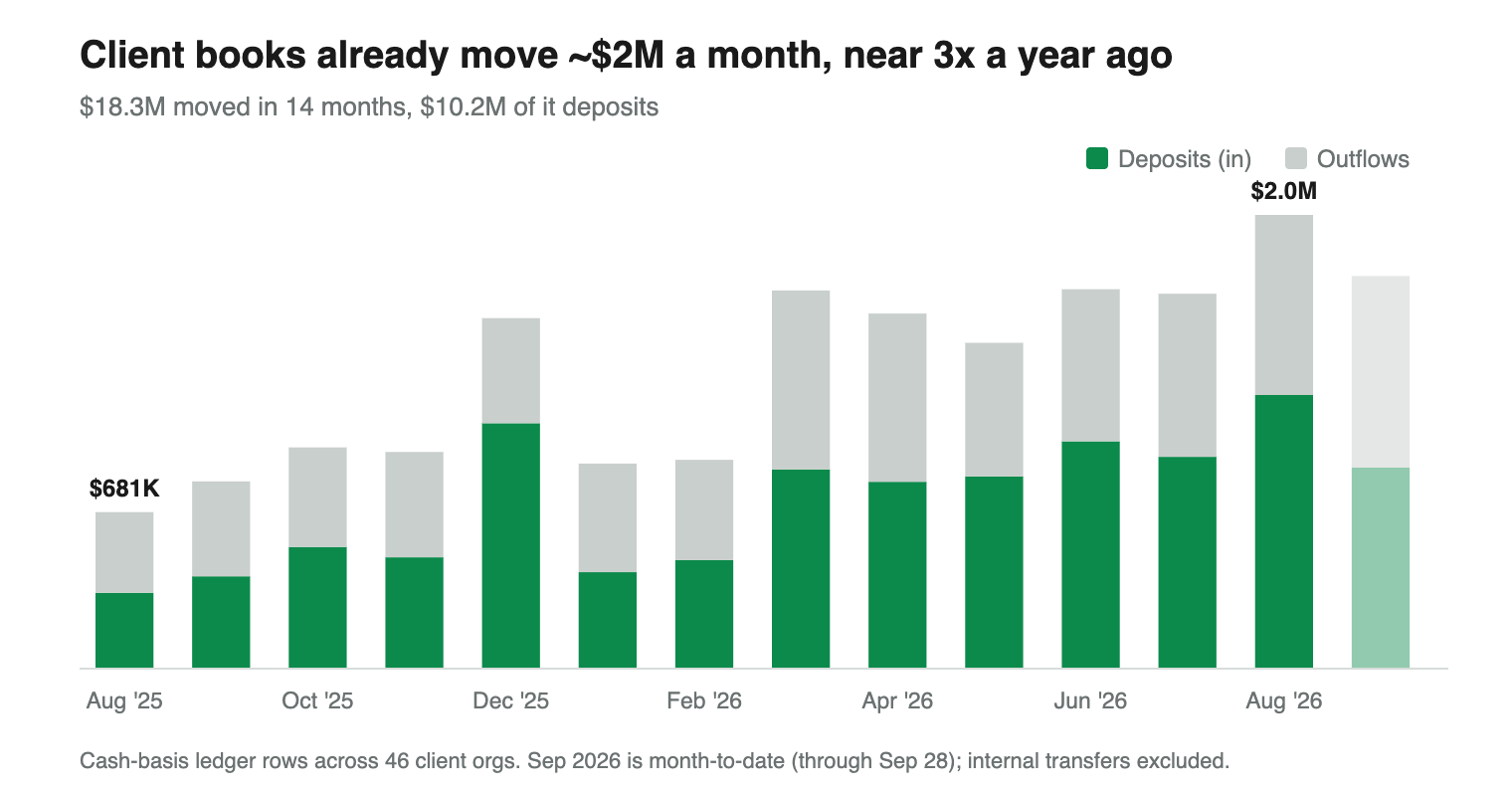
Over the trailing 14 months, client books moved $18.3M: $10.2M of deposits, $8.1M of outflows, 35,460 transactions, plus roughly $6.6M of internal transfers excluded from the chart. At the last 3 complete months' run rate, that is about $21M/yr of money movement, $12M/yr of it deposits. The $8.6M/yr of spend becomes on the order of $215K/yr of interchange at 2.5% once it rides our card.
These are the compliance numbers for a sponsor-bank conversation today, before a single acquired firm's clients are added. They have grown near 3x in 12 months on the services wedge alone.
8. Own the channel, don't rent it
Ramp proved the mechanic: the accounting firm is the distribution channel to SMB finance, and its 5,000 partnerships let accountants recommend Ramp's card at near-zero acquisition cost. But Ramp rents the channel and monetizes 1 product. The full version of the play is to own the channel: buy the firms.
The supply side has never been better: the US lost 340,000 accountants in 5 years, and 75% of CPAs are near retirement. That is a decade-long window of small practices with loyal clients and no succession plan, changing hands at low multiples. Private equity rolls them up to keep running them with humans at 15-20% margins, while we buy them to convert them.
The per-firm playbook:
- Acquire a small accounting or bookkeeping practice: its client list, its trust, its recurring revenue.
- Convert the books onto the autopilot. The agent absorbs the work. Margins move from services-grade toward software-grade, which alone justifies the purchase price.
- Cross-sell the stack into a client that already trusts us with its books: banking first, because it makes the books self-writing, then the card, payroll, and tax. This is the Ramp motion, except we keep 100% of the economics on every product instead of interchange on one.
Each acquired dollar of services revenue carries attached interchange, deposits, payroll, and eventually credit that a PE roll-up structurally cannot activate. That lets us outbid PE on the same firm and still win on returns. The roll-up is not the business. It is the customer-acquisition engine for the integrated stack.
9. The next 10 years
| Phase | Years | What happens | Gate to the next phase |
|---|---|---|---|
| Product dev | 2026 | Banking and credit cards ship. Books and tax already run by the agent | Full stack live for existing clients |
| Prove cross-sell | 2027 | Payroll ships. Banking and card attach across the existing client base. Buy pilot firms | Cross-sell attach and conversion playbook proven |
| Roll-up | 2028-2031 | Dozens of firms acquired. Cross-sell at scale. Underwriting from our own books | Integrated client at 3x single-product revenue |
| Full stack | 2032-2036 | Charter or deep sponsorship. Credit on our own balance sheet. A2B settlement is the default | The firm and the bank are the same company |
Each gate is a proof, not a date. Conversion economics unlock the roll-up capital, and integrated-client economics unlock the balance-sheet phase.
10. What could stop us
- Regulatory drag. Money transmission, card program compliance, and lending licensure gate the later phases. A charter path is measured in years. Sponsor-bank and program-manager structures carry us most of the decade.
- Conversion churn. Roll-ups fail on integration. Ours fails if acquired clients churn during migration to the autopilot. The pilot acquisitions exist to prove retention before capital scales.
- A2B timing. Natural's own memo concedes agent-executed payment volume barely exists yet. If it stays nascent, the services and roll-up economics stand alone. The payments upside is sequenced, not load-bearing.
Sequoia sized the work. Natural sized the money movement. The trillion-dollar company is the one that does both for the same client on the same ledger. In 10 years, the firm and the bank are the same company.